🇺🇸🇮🇷 The 2026 U.S.–Iran War: A Strategic Analysis of Escalation, Narratives, and Probable Outcomes
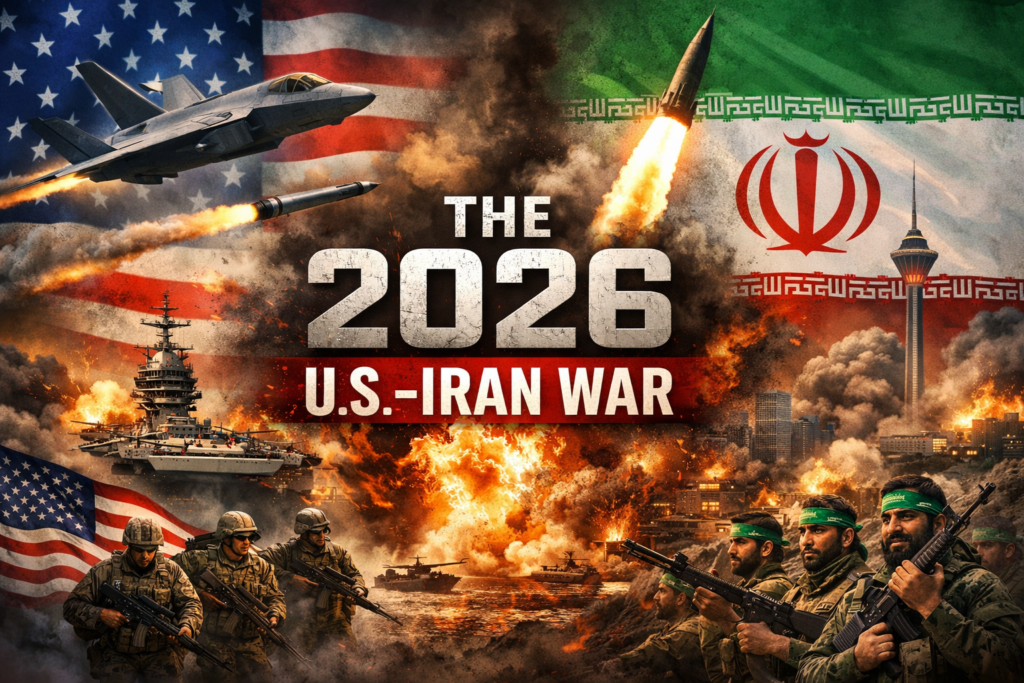
Introduction: A War of Intentions, Miscalculations, and Managed Escalation
The 2026 war between the United States and Iran did not begin as a conventional war, nor has it evolved into one. What initially appeared to be a short-duration precision campaign rapidly transformed into a multi-domain, regionally entangled conflict involving missiles, cyberwarfare, proxy actors, and global economic disruption.
Launched on February 28, 2026, the conflict reflects deeper structural tensions: nuclear proliferation fears, regional power competition, domestic political signaling, and the fragility of deterrence in a multipolar world. What makes this war particularly significant is not just its military dimension, but the contradiction between political narratives and battlefield realities, and the way it is reshaping global alignments.
This report reconstructs the war chronologically, examines its operational and strategic dimensions, analyzes competing narratives, and assesses whether the conflict is heading toward termination or transformation.
The Opening Phase: Shock, Awe, and Immediate Retaliation
The war began with a coordinated U.S.–Israeli offensive targeting Iran’s nuclear infrastructure, missile systems, and high-value military sites. The stated objective from Washington was clear: neutralize Iran’s strategic capabilities and compel either behavioral change or regime collapse. Early statements from U.S. leadership framed the operation as both necessary and decisive, suggesting a limited timeline and a high degree of control.
However, within hours, Iran responded with Operation “True Promise IV,” launching ballistic missiles and drones toward Israeli urban centers and U.S. military installations across the Gulf. Targets included bases in Qatar, Bahrain, and the UAE. This immediate retaliation transformed the conflict from a bilateral strike campaign into a regional war theatre.
The speed of escalation revealed a critical miscalculation: Iran’s capacity and willingness to respond across multiple fronts had been underestimated. Rather than absorbing the initial shock, Tehran demonstrated that it retained both operational readiness and strategic intent.
The First Two Weeks: Expansion and Narrative Formation
As the war entered its first two weeks, it became evident that the United States had achieved tactical surprise but not strategic paralysis. Iran continued launching missiles at a sustained pace, while allied and proxy actors began engaging in secondary theatres. Hezbollah activity along the Israel-Lebanon border intensified, and attacks on U.S.-aligned infrastructure in the broader region signaled a widening conflict.
At the same time, the war began to develop a second front: the information and narrative domain. U.S. leadership alternated between declaring success and signaling escalation. Statements ranged from describing the operation as a “minor excursion” to demanding Iran’s “unconditional surrender.” These inconsistencies weakened the coherence of U.S. strategic communication.
Iran, by contrast, maintained a relatively consistent narrative. It framed its actions as defensive retaliation and emphasized sovereignty and resistance. Over time, its messaging subtly evolved to include diplomatic signals, particularly emphasizing that its conflict was not with Western populations but with U.S. policy.
This divergence in communication strategies had tangible effects. While the United States dominated the airspace, Iran began to gain ground in the perception battle, especially among non-aligned states and segments of global public opinion.
Mid-War Escalation: Energy, Cyberwarfare, and Strategic Depth
By mid-March, the conflict entered a more dangerous phase characterized by target diversification and systemic disruption. U.S. strikes expanded to include Iran’s energy infrastructure, most notably the bombing of Kharg Island, a critical oil export hub. This marked a shift from purely military objectives to economic warfare.
Iran responded asymmetrically. Missile strikes intensified against Israeli urban zones, while drone attacks targeted industrial facilities in the Gulf. Simultaneously, Iran launched one of the most significant cyber offensives in recent history, reportedly disrupting segments of U.S. infrastructure and financial systems.
At this stage, the war had fully transitioned into a hybrid conflict. It was no longer about territorial gains or conventional victory but about:
- Degrading the opponent’s economic resilience
- Maintaining deterrence credibility
- Influencing global markets and alliances
The impact was immediate and global. Oil prices surged beyond $100 per barrel, shipping routes faced disruptions, and fears of a broader economic crisis began to mount. The war had effectively expanded beyond the battlefield into the global economic system.
The Strategic Plateau: Victory Claims vs. Operational Reality
As the war approached its fourth and fifth weeks, a noticeable gap emerged between official U.S. statements and battlefield realities. Washington repeatedly suggested that Iranian capabilities had been significantly degraded and that the war was nearing completion. Yet, Iranian missile launches continued, albeit at a reduced rate, and no decisive collapse of Iranian command structures occurred.
This phase can be described as a strategic plateau. Neither side was escalating dramatically, but neither was disengaging. The United States maintained air superiority and continued targeted strikes, while Iran preserved enough capability to sustain deterrence and avoid capitulation.
This equilibrium reflects a deeper structural truth: modern wars between capable states rarely end quickly unless one side collapses internally. In this case, despite infrastructure damage and leadership losses, Iran’s political system remained intact, and its military retained operational coherence.
Global Reactions: A Fragmented International Order
The international response to the war highlights the emergence of a multipolar world order.
Russia adopted a position of indirect support for Iran, benefiting economically from rising energy prices while opposing U.S. actions diplomatically. China maintained a pragmatic stance, continuing to purchase Iranian oil and leveraging the situation to strengthen its economic position.
European countries, meanwhile, found themselves in a precarious situation. While formally aligned with the United States, they faced severe energy insecurity and domestic political pressure to de-escalate the conflict. Gulf states, despite hosting U.S. bases, became direct targets of Iranian retaliation, exposing their vulnerability.
This fragmentation underscores a critical shift: the United States no longer operates in a system where its actions automatically generate unified allied support. Instead, each actor is pursuing its own strategic and economic interests, often in contradiction to one another.
Expert Assessments: Consensus Without Clarity
Military analysts widely agree that the United States achieved tactical success but not strategic victory. Iran’s infrastructure has been damaged, and its operational tempo reduced, but its core capabilities remain intact.
Legal experts have raised concerns about the proportionality and targeting of certain strikes, suggesting potential violations of international law. Economic analysts warn that prolonged conflict could trigger broader financial instability, particularly if energy disruptions intensify.
Strategic experts converge on a key point: the war has not achieved its primary political objective. There is no regime change in Iran, no comprehensive dismantling of its missile program, and no clear pathway to a decisive conclusion.
The Nature of the Conflict: Neither War Nor Peace
The defining characteristic of the 2026 U.S.–Iran war is its ambiguity. It is neither a full-scale war nor a contained operation. Instead, it occupies a space best described as a managed high-intensity conflict.
Several factors explain this:
- Mutual Constraints:
Both sides seek to avoid full-scale escalation that could trigger catastrophic regional consequences. - Deterrence Preservation:
Iran aims to demonstrate resilience, while the U.S. seeks to maintain dominance without overcommitment. - Global Pressure:
Economic and diplomatic pressures incentivize de-escalation but do not enforce it.
This results in a conflict that continues at varying levels of intensity without a clear endpoint.
Probable Outcomes: Scenarios and Strategic Trajectories
The most likely trajectory is not a decisive end but a gradual transition into a lower-intensity confrontation. Direct large-scale strikes may decrease, but proxy conflicts, cyber operations, and periodic escalations are likely to persist.
A full regional war remains possible but unlikely, as it would impose unacceptable costs on all parties involved. Similarly, regime collapse in Iran appears improbable in the absence of significant internal upheaval.
Instead, the conflict is likely to evolve into a long-term geopolitical standoff, resembling aspects of Cold War dynamics but with more fluid and decentralized engagement patterns.
Final Assessment: Stop or Go?
The central question—whether the war is stopping or continuing—does not have a binary answer. The evidence suggests that the war is slowing in intensity but not ending in substance.
The United States is signaling a desire to conclude major operations while retaining the option to escalate. Iran is balancing continued resistance with subtle diplomatic outreach. Both sides are effectively managing the conflict rather than resolving it.
Conclusion: A War Without Victory
The 2026 U.S.–Iran war illustrates the limits of military power in achieving political objectives. Despite significant destruction and sustained operations, neither side has secured a decisive advantage.
What has emerged instead is a new equilibrium:
- The United States retains military superiority but faces strategic constraints
- Iran endures damage but preserves sovereignty and deterrence
- The global system absorbs the shock but becomes more fragmented
In this sense, the war is not ending—it is transforming.
It is becoming a prolonged contest of endurance, influence, and narrative—
not a war that concludes, but one that persists in different forms.