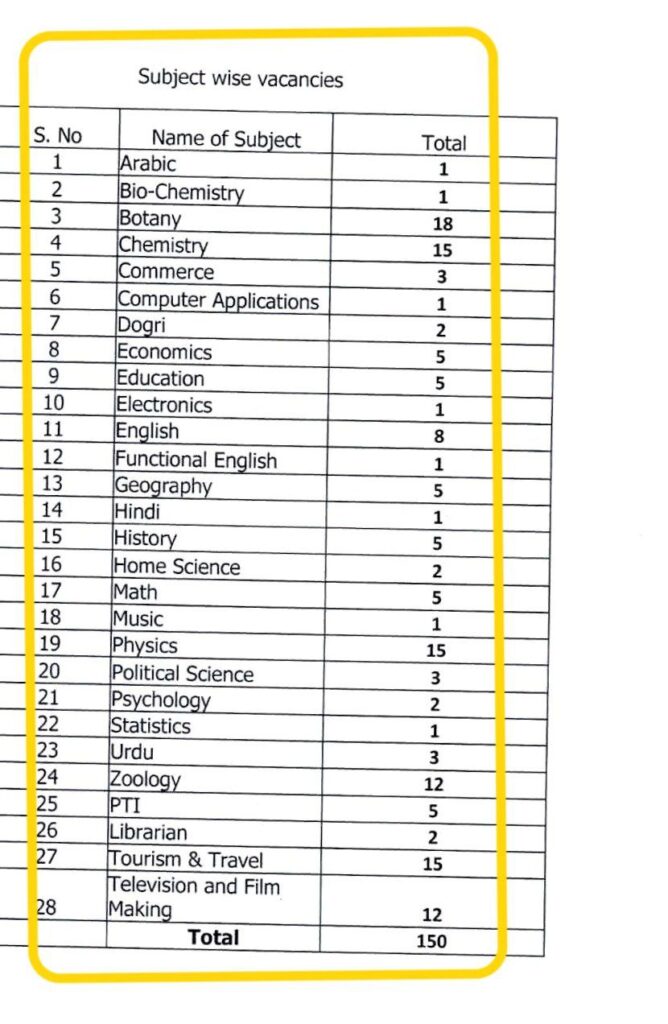
In November 2025, an RTI application was filed seeking clear, official information on the vacancy position of Assistant Professors and allied posts in government degree colleges of Jammu and Kashmir. The Higher Education Department responded by sharing a detailed, subject‑wise vacancy statement that lists a total of 150 posts lying vacant across different disciplines.
Key highlights from the vacancy list
The RTI reply shows that the 150 vacancies are spread over traditional arts, core sciences, languages, social sciences, and specialised vocational subjects, reflecting the diverse academic profile of J&K colleges. Posts are shown not only for Assistant Professors but also for Librarian and PTI, indicating that both teaching and student‑support services are currently understaffed in many institutions.
Some of the notable features visible in the subject‑wise breakup you shared include:
- Strong presence of science subjects such as Botany, Chemistry, Physics and Zoology, which together account for a large chunk of the total vacancies, underlining laboratory and practical‑oriented teaching needs.
- Healthy number of positions in social sciences and humanities like English, History, Geography, Economics, Political Science, Urdu and Hindi, which are core to undergraduate curricula in most colleges.
- Vacancies in professional and emerging areas such as Computer Applications, Tourism & Travel, Education, Psychology and Television & Film Making, hinting at the department’s intent to strengthen job‑oriented and skill‑based programmes.
Why this RTI reply matters
The disclosure is significant because it gives aspiring Assistant Professors a transparent picture of which subjects are likely to be advertised in upcoming JKPSC recruitment notifications for the Higher Education Department. [2][3] For candidates who have already qualified NET/JRF or hold PhD degrees, the subject‑wise data helps in planning exam strategy, research profiles and even the choice of optional subjects for competitive examinations.
For civil society and student groups, the data exposes the extent of faculty shortage in government colleges and allows better monitoring of how quickly sanctioned posts are being filled. It also strengthens the culture of accountability, showing how RTI can be used to obtain granular information that is not always visible in routine government press notes or advertisement notifications.
Implications for future recruitment
Given that JKPSC is the recruiting agency for Assistant Professors in the Higher Education Department, these 150 vacancies are expected to be referred to the commission in phases, alongside other ongoing advertisements for college and medical faculty posts. Recent recruitment drives for Assistant Professors, Lecturers and medical faculty indicate that the commission is steadily clearing backlogs, so these posts, once formally referred, may translate into multiple subject‑wise notifications over the next recruitment cycles.
Aspirants should therefore:
- Regularly check the JKPSC website and official notifications of the Higher Education Department for advertisement numbers, eligibility details and syllabus.
- Keep documents like PG marksheets, NET/JRF certificates, PhD notifications, reservation/category certificates and experience proofs updated so that the application process is smooth once posts are advertised.
- Continue using RTI judiciously for clarifications such as college‑wise distribution, reservation‑wise break‑up or status of referral to JKPSC, while respecting all procedural rules laid down for RTI filing.