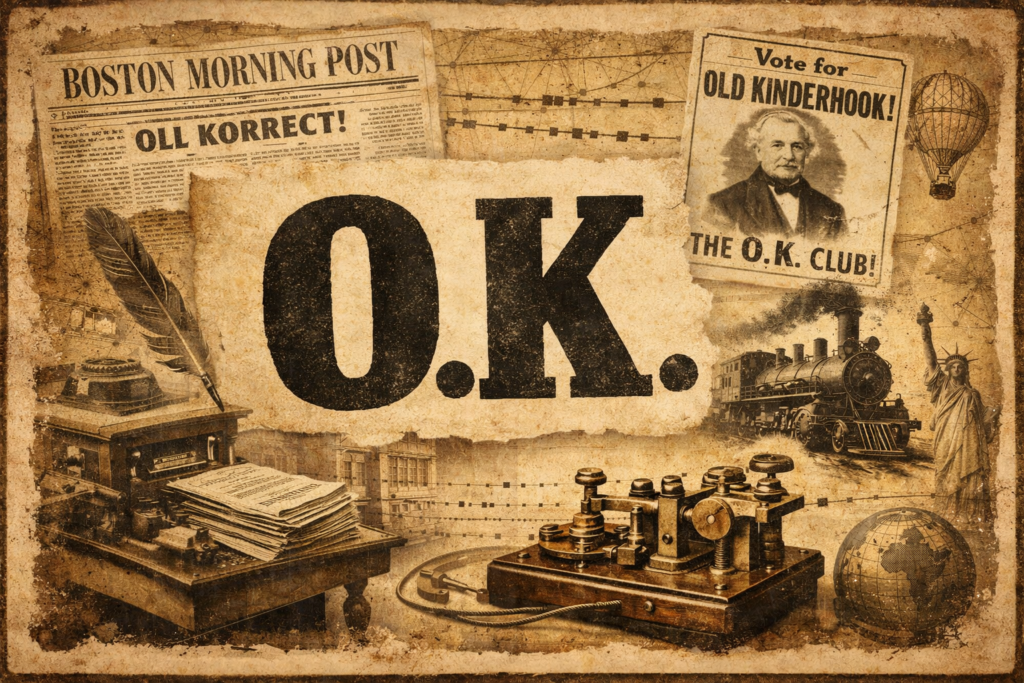
The word “OK” is so ordinary today that we hardly give it a second thought. We type it in texts, hear it in conversations, see it in languages around the world … but its story? That’s anything but ordinary. What began as a 19th-century joke in a Boston newspaper ultimately became perhaps the most globally recognizable word ever.
🌟 A Joke That Took Over the World
Believe it or not, OK started out as a gag.
On March 23, 1839, the Boston Morning Post printed the letters “O.K.” — not as a serious phrase, but as part of a humorous trend of deliberately misspelling common expressions and then abbreviating them. In this case, it stood for “oll korrect” — an intentionally mangled spelling of “all correct.” The joke wasn’t meant to be profound — just a playful bit of wordplay among editors and readers.
At the time, bizarre abbreviations were all the rage in the press. Writers had fun turning ordinary phrases into comedic initials: no use became KY for “know yuse,” all right became O.W. for “oll wright,” and all correct became O.K. — the only one that stuck.
🎩 From Newspaper Gag to Political Catchphrase
Just a year later, OK found its first big audience beyond the newsroom.
In the 1840 U.S. presidential election, supporters of Martin Van Buren — nicknamed “Old Kinderhook” after his hometown in New York — adopted “OK” as part of his campaign slogan: “Vote for OK!” They formed “OK Clubs” across the country, pushing the term into public awareness far beyond its satirical origins.
Although Van Buren ultimately lost the election, the phrase took off. Americans began using it in everyday conversation — and by the mid-19th century, “OK” was already spreading beyond the original joke that birthed it.
🔎 A Century of Curious Theories
Once OK became part of common speech, many curious explanations emerged about its origin — and for more than a century, scholars debated them.
Some contenders included:
- A Native American connection: Some thought it came from the Choctaw word okeh, meaning something like “it is so” — a theory even favored at times by U.S. President Woodrow Wilson.
- Foreign language roots: The Greek phrase ola kala (“all good”) and Scottish expressions like och aye were proposed by early enthusiasts.
- Other fanciful ideas: Some claimed OK came from World War shorthand for “zero killed,” or that it was stamped on goods from a trusted manufacturer.
None of these held up to rigorous scrutiny, but their variety shows just how fascinated people have been with deciphering a word we use without thinking.
📚 The Real Origin Revealed by Linguistic Sleuthing
It wasn’t until the 1960s that linguists finally traced OK back to its true roots.
American language scholar Allen Walker Read combed through historical newspapers and documents and demonstrated that the first confirmed use of “O.K.” was that Boston newspaper joke from 1839 — making the playful “oll korrect” origin the best-supported explanation.
Read’s research convinced most language experts that OK didn’t come from foreign languages or ancient words — it came from American humor and editorial playfulness.
🌍 From Telegraphs to Text Messages
Once its use spread, OK evolved with technology. Telegraph operators liked it because it was short and easy to send. Over time, it came to mean not just “all correct,” but agreement, approval, acknowledgment, and sometimes even moderate quality (“That movie was OK.”).
Eventually, OK went global — borrowed into languages around the world and understood by millions of people who don’t speak English as their first language. Today, it’s one of the most recognized spoken or written words on the planet.
✍️ More Than Just Two Letters
What makes OK remarkable is how ordinary it feels now versus how unusual its beginning was. It started as:
- a joke
- a trend
- an abbreviation of a joke
- a political slogan
- and ultimately, a global linguistic phenomenon
No other word has traveled so far from such humble — and humorous — beginnings.
So the next time you hit “OK” in a text, remember — you’re carrying forward a linguistic legacy that began in a newsroom full of jokesters nearly 200 years ago.