Answer the following descriptive category questions in about 500 words each. Each
question carries 20 marks.
3 x 20 = 60
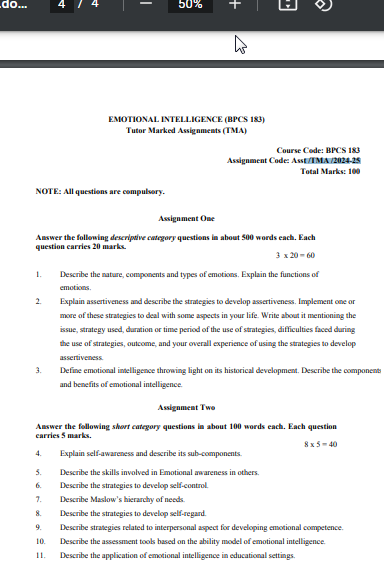
- Describe the nature, components and types of emotions. Explain the functions of
emotions. - Explain assertiveness and describe the strategies to develop assertiveness. Implement one or
more of these strategies to deal with some aspects in your life. Write about it mentioning the
issue, strategy used, duration or time period of the use of strategies, difficulties faced during
the use of strategies, outcome, and your overall experience of using the strategies to develop
assertiveness. - Define emotional intelligence throwing light on its historical development. Describe the components
and benefits of emotional intelligence.
1. Describe the nature, components, and types of emotions. Explain the functions of emotions.
Nature of Emotions: Emotions are complex psychological and physiological responses to external or internal stimuli. They are an integral part of human experience, influencing thoughts, behaviors, and decisions. Emotions arise from cognitive evaluations of events and are accompanied by physical reactions such as increased heart rate, facial expressions, and hormonal changes. These reactions are both involuntary and automatic, but they can also be consciously managed and expressed.
Components of Emotions: Emotions consist of three primary components:
- Cognitive Component: This involves the mental evaluation of a situation that triggers an emotional response. For example, recognizing a dangerous situation might evoke fear.
- Physiological Component: This refers to the bodily reactions that occur in response to emotions. For instance, fear can cause an increase in heart rate, sweating, and tension in muscles.
- Behavioral Component: This includes the outward expressions of emotions, such as facial expressions, body language, and vocal tone. For example, sadness may be expressed by crying or slumped posture.
Types of Emotions: Emotions can be broadly categorized into basic and complex emotions:
- Basic Emotions: These are universal and innate emotions shared across cultures. The basic emotions, as identified by psychologist Paul Ekman, include happiness, sadness, anger, fear, surprise, and disgust. They are fundamental and can be easily recognized through facial expressions.
- Complex Emotions: These are a combination of basic emotions and are influenced by individual experiences and social contexts. Examples include shame, guilt, pride, jealousy, and embarrassment. They are often learned and shaped by societal norms and values.
Functions of Emotions: Emotions serve several important functions in human life:
- Adaptive Function: Emotions help individuals respond to environmental stimuli in ways that enhance survival. For instance, fear can trigger a “fight or flight” response when encountering danger, while happiness can motivate behavior that seeks rewarding experiences.
- Social Function: Emotions are essential in social interactions as they facilitate communication and understanding. Facial expressions, for example, convey emotions that help individuals understand the feelings of others, fostering empathy and cooperation.
- Cognitive Function: Emotions can influence decision-making processes and help prioritize responses to different situations. For instance, fear might lead to caution, while excitement could encourage exploration.
- Motivational Function: Emotions can drive individuals to achieve goals. Positive emotions, such as excitement, can motivate action, while negative emotions, such as frustration, can lead to problem-solving.
2. Explain assertiveness and describe the strategies to develop assertiveness. Implement one or more of these strategies to deal with some aspects of your life. Write about it mentioning the issue, strategy used, duration or time period of the use of strategies, difficulties faced during the use of strategies, outcome, and your overall experience of using the strategies to develop assertiveness.
Assertiveness: Assertiveness is the ability to express one’s thoughts, feelings, and needs in an open, honest, and respectful manner without being aggressive or passive. It involves standing up for oneself while respecting others’ rights and opinions. Assertiveness is often considered a key aspect of emotional intelligence and is vital for maintaining healthy relationships, improving self-esteem, and reducing stress.
Strategies to Develop Assertiveness:
- Using “I” Statements: This strategy involves expressing feelings or needs in a way that focuses on one’s own experiences, rather than blaming or criticizing others. For example, saying “I feel frustrated when the task is delayed” instead of “You always delay the task” can be more constructive.
- Setting Boundaries: It is important to set limits on what is acceptable behavior from others. This can involve saying “no” when necessary, without feeling guilty. Learning to assert boundaries is key to maintaining personal well-being.
- Practicing Active Listening: Assertiveness is not just about speaking up but also about listening to others. By actively listening, one can engage in balanced communication and show respect for others’ opinions, while also asserting one’s own.
- Non-Verbal Communication: Body language, facial expressions, and tone of voice play a crucial role in assertive communication. Maintaining eye contact, standing tall, and speaking clearly can all reinforce assertiveness.
Implementation of Strategies in Life:
- Issue: One common challenge I faced was dealing with a colleague who frequently interrupted me during meetings, which made me feel unheard and frustrated.
- Strategy Used: I implemented the “I” statements strategy and practiced active listening. I calmly said, “I feel frustrated when I’m interrupted, and I would appreciate the chance to finish my point.”
- Duration: I used this strategy over the course of a month during team meetings, whenever the interruptions occurred.
- Difficulties Faced: Initially, I felt uncomfortable expressing myself assertively and worried about potential conflict. It was also challenging to consistently stay calm in the moment.
- Outcome: After a few weeks, my colleague began to recognize the issue and allowed me to finish speaking without interruptions. I also felt more confident in expressing my thoughts, and the working environment improved.
- Overall Experience: The experience helped me understand the importance of clear communication and self-respect. While there were challenges, the long-term benefits of assertiveness were evident, as I felt more in control of my interactions and relationships.
3. Define emotional intelligence throwing light on its historical development. Describe the components and benefits of emotional intelligence.
Emotional Intelligence (EI): Emotional intelligence refers to the ability to recognize, understand, manage, and influence emotions—both in oneself and others. It encompasses a variety of skills related to emotional awareness, regulation, empathy, and social interaction. The concept of emotional intelligence was popularized by psychologist Daniel Goleman in the 1990s, though its roots can be traced to earlier psychological theories.
Historical Development of Emotional Intelligence:
- Early Foundations: The concept of emotional intelligence can be traced back to the work of early psychologists such as Edward Thorndike, who introduced the idea of “social intelligence” in the 1920s. He emphasized the importance of understanding and managing emotions in social interactions.
- 1970s – Howard Gardner’s Theory: In the 1970s, Howard Gardner proposed the theory of multiple intelligences, which included interpersonal and intrapersonal intelligence, both of which are essential aspects of emotional intelligence.
- 1995 – Daniel Goleman’s Model: Daniel Goleman’s book Emotional Intelligence (1995) brought the concept into the mainstream, defining EI as a set of competencies that enable individuals to manage their emotions, establish relationships, and navigate social complexities. Goleman’s model gained widespread recognition and was instrumental in influencing how EI is understood in both psychology and business.
Components of Emotional Intelligence: Goleman’s model of emotional intelligence consists of five key components:
- Self-awareness: The ability to recognize and understand one’s own emotions and how they impact thoughts and behavior. This includes an awareness of strengths, weaknesses, and emotional triggers.
- Self-regulation: The ability to manage and control one’s emotions, especially in stressful or challenging situations. It involves staying calm and composed and avoiding impulsive reactions.
- Motivation: The ability to harness emotions to pursue goals with energy and persistence. It involves maintaining a positive outlook and remaining focused despite setbacks.
- Empathy: The ability to understand and share the feelings of others. Empathy helps build strong relationships and fosters cooperation.
- Social Skills: The ability to manage relationships effectively, including communication, conflict resolution, and collaboration. Social skills are essential for leadership, teamwork, and interpersonal interactions.
Benefits of Emotional Intelligence:
- Improved Relationships: EI helps individuals communicate effectively, build trust, and navigate social complexities, leading to stronger relationships both personally and professionally.
- Better Mental Health: High EI is associated with lower levels of stress, anxiety, and depression, as individuals with high EI can manage their emotions more effectively.
- Leadership and Success: Leaders with high emotional intelligence are better equipped to inspire and motivate their teams, make sound decisions, and manage conflict.
- Enhanced Decision-Making: Emotional intelligence helps individuals make decisions that consider both rational and emotional aspects, leading to more balanced and effective choices.
- Increased Job Performance: Employees with high EI are often better at managing workplace challenges, collaborating with colleagues, and handling criticism, leading to greater job satisfaction and productivity.
In conclusion, emotional intelligence is a critical skill that influences personal growth, professional success, and overall well-being. It enhances our ability to understand and manage emotions, fostering healthier relationships and more effective communication.
4. Explain self-awareness and describe its sub-components.
Self-awareness refers to the ability to recognize and understand one’s own emotions, strengths, weaknesses, and their impact on thoughts and behavior. It is a crucial component of emotional intelligence, as it helps individuals make informed decisions and regulate emotions effectively. Sub-components of self-awareness include:
- Emotional Awareness: Recognizing one’s own emotions as they occur and understanding their causes.
- Accurate Self-Assessment: Realistically assessing one’s strengths, weaknesses, and capabilities.
- Self-Confidence: A strong sense of one’s worth and abilities, based on an accurate understanding of oneself.
5. Describe the skills involved in emotional awareness in others.
Emotional awareness in others involves recognizing and understanding the emotions of those around us. It is key to empathy and effective communication. Skills involved in emotional awareness include:
- Empathy: The ability to sense and understand another person’s feelings and perspectives.
- Active Listening: Paying attention to both verbal and non-verbal cues, such as tone, body language, and facial expressions.
- Non-verbal Cue Recognition: Interpreting emotional expressions like facial expressions and posture to understand others’ emotions.
- Empathic Response: Acknowledging and responding appropriately to others’ emotions.
6. Describe the strategies to develop self-control.
Self-control involves managing and regulating one’s emotions and behaviors, especially in challenging situations. Strategies to develop self-control include:
- Mindfulness: Practicing mindfulness through meditation or deep breathing exercises helps maintain emotional balance.
- Cognitive Reappraisal: Changing the way we think about an emotion-triggering situation to reduce its impact.
- Delayed Gratification: Practicing patience and resisting immediate impulses by focusing on long-term goals.
- Setting Boundaries: Recognizing personal limits and learning to say no when necessary.
- Stress Management Techniques: Engaging in physical activities, relaxation exercises, or hobbies to reduce stress.
7. Describe Maslow’s hierarchy of needs.
Maslow’s hierarchy of needs is a psychological theory that organizes human needs into five levels, arranged in a pyramid-like structure:
- Physiological Needs: Basic survival needs such as food, water, and sleep.
- Safety Needs: Protection from harm, stability, and security.
- Love and Belonging: The need for social relationships, affection, and a sense of community.
- Esteem Needs: The desire for self-respect, recognition, and achievement.
- Self-Actualization: The pursuit of personal growth, creativity, and realizing one’s full potential. Maslow suggested that higher-level needs become important only after basic needs are fulfilled.
8. Describe the strategies to develop self-regard.
Self-regard refers to having a healthy sense of self-worth and confidence. Strategies to develop self-regard include:
- Positive Self-Talk: Replacing negative thoughts with positive affirmations and constructive self-reflection.
- Setting and Achieving Goals: Accomplishing small goals can enhance confidence and self-esteem.
- Self-Care: Prioritizing physical and mental health through exercise, nutrition, and rest.
- Learning from Failures: Viewing mistakes as opportunities for growth rather than as reflections of self-worth.
- Surrounding Oneself with Positive Influences: Spending time with people who support and uplift you.
9. Describe strategies related to interpersonal aspects for developing emotional competence.
Emotional competence involves recognizing, understanding, and managing emotions effectively in interactions with others. Strategies to develop emotional competence in interpersonal relationships include:
- Active Listening: Paying full attention and responding thoughtfully to others.
- Empathy: Understanding and sharing the feelings of others to create a strong connection.
- Non-verbal Communication: Paying attention to body language, tone, and facial expressions to enhance communication.
- Conflict Resolution Skills: Handling disagreements with patience, understanding, and open-mindedness.
- Building Trust: Consistently being honest, reliable, and respectful in interactions.
10. Describe the assessment tools based on the ability model of emotional intelligence.
The ability model of emotional intelligence, developed by Mayer and Salovey, focuses on the ability to process emotional information and use it effectively. Assessment tools based on this model include:
- Mayer-Salovey-Caruso Emotional Intelligence Test (MSCEIT): A performance-based test that measures the ability to perceive, facilitate, understand, and manage emotions.
- Emotional Intelligence Scale (EIS): This scale assesses emotional intelligence by measuring four branches: perception, use, understanding, and management of emotions. These tools assess how well individuals can use emotions to enhance thinking and decision-making.
11. Describe the application of emotional intelligence in educational settings.
In educational settings, emotional intelligence plays a crucial role in fostering a positive learning environment. Applications include:
- Teacher-Student Relationships: Teachers with high EI can understand and manage their own emotions and empathize with students, leading to more supportive interactions.
- Classroom Management: Teachers can use emotional intelligence to maintain a calm, focused, and productive classroom atmosphere by managing emotions effectively.
- Student Well-being: Teaching students emotional regulation, empathy, and social skills can enhance their academic performance and personal growth.
- Conflict Resolution: Emotional intelligence helps resolve conflicts in the classroom, fostering a sense of community and cooperation among students.